The Scenario
Picture a visitor arriving at a hospital for the first time. They are already stressed. The building has several entrances, long corridors, similar looking floors, and signs that only make sense if you already know where you are going.
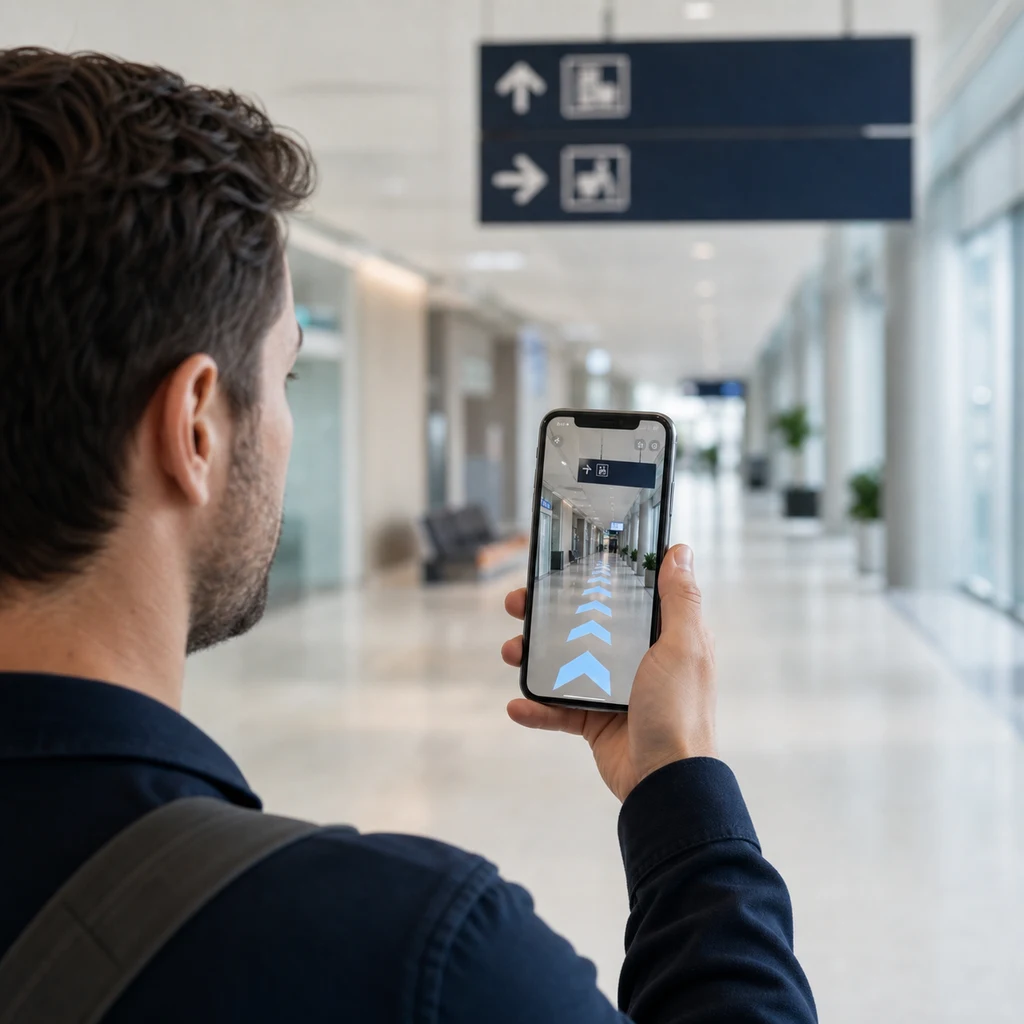
Now imagine they open a phone, choose the destination, and see simple directions appear directly in the space around them. A calm arrow points toward the right corridor. A small note confirms the elevator. The experience does not feel like a map. It feels like someone quietly guiding them.
That is the promise of AR navigation. It helps people move with more confidence when the space itself is difficult to understand.
How It Works
AR navigation combines position, orientation, and visual guidance.
Outdoors, the experience can use GPS, compass direction, and camera based AR overlays. Indoors, where GPS is usually weak, the system may use visual positioning, floor maps, beacons, QR anchors, or a hybrid setup. The goal is always the same. Understand where the person is, understand where they want to go, then show the next step in a way that reduces doubt.
The best experiences do not overload the screen. They show only what the user needs in the moment. A direction. A distance. A confirmation that they are still on the right path.
The Technical Approach
A useful navigation system is built around trust, not just arrows.
- Map Preparation: The space is translated into a navigation model with entrances, paths, stairs, elevators, restricted areas, and destination points.
- Positioning Strategy: The project chooses the right mix of GPS, visual positioning, QR anchors, or indoor location signals depending on the building and the expected user flow.
- Guidance Design: The AR layer is kept simple, with clear turn prompts, destination cues, and graceful fallback states when position confidence drops.
This is where many projects succeed or fail. If the system is not honest about uncertainty, users stop trusting it. The interface should guide clearly when it can, and recover calmly when it cannot.
Why It Matters
Navigation is not only about movement. It is about reducing friction wherever people arrive somewhere unfamiliar.
- Corporate campuses: New employees and guests find rooms and services faster, without stopping to ask.
- Museums and exhibitions: Visitors are guided through the space, with context added at the right moment.
- Hospitals: Patients and visitors arrive less stressed, because the way to the right door is clear.
- Factories and warehouses: Teams get support for training, safety, and the flow of tasks.
For businesses, the value is practical. Fewer lost visitors. Better first impressions. Less staff interruption. A smoother journey from arrival to destination.
AR navigation works best when it disappears into the task. The user should remember that the experience helped them, not that the technology tried to impress them.