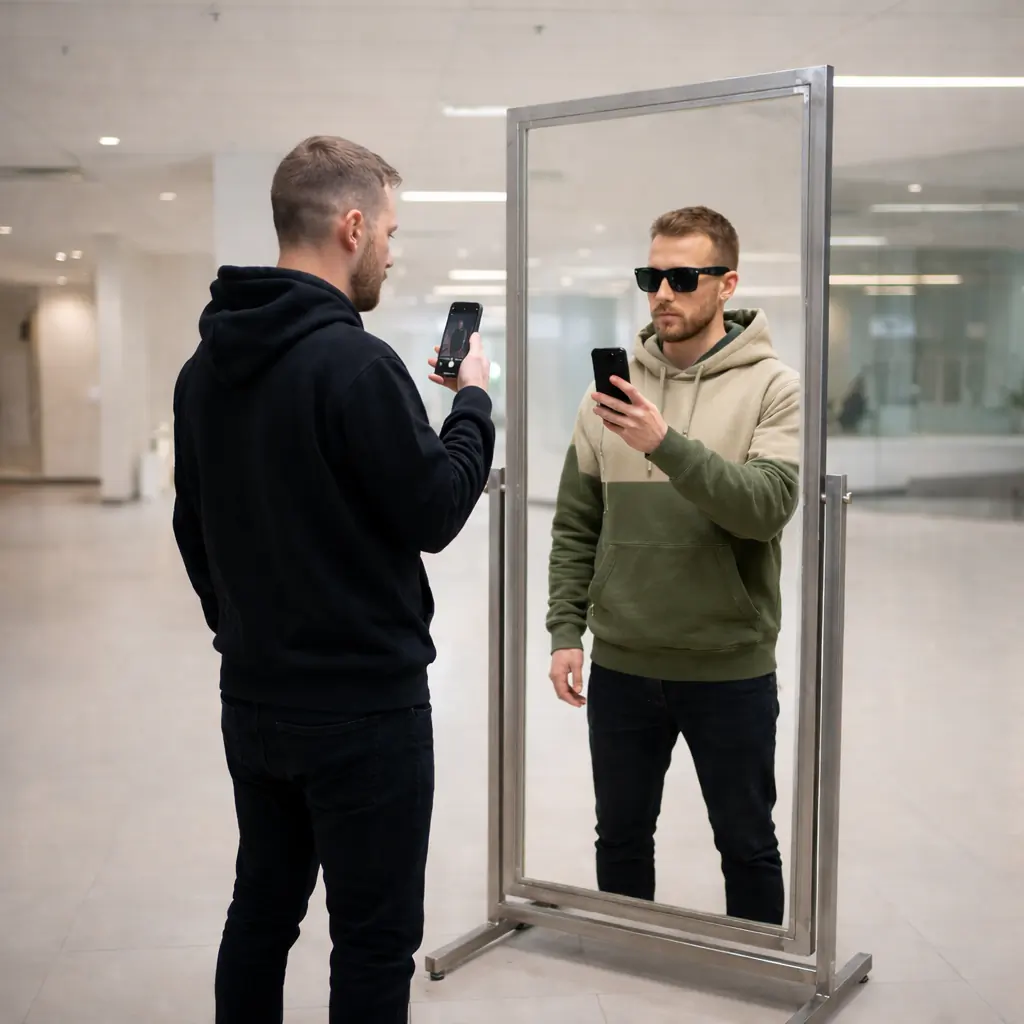
The Scenario
A customer likes a pair of glasses online, but they hesitate. The product photo looks good, but the real question is personal. Will it suit their face?
Now they open the camera and see the frame fitted to their own features in real time. They turn slightly. The glasses stay aligned. They compare colors. The decision becomes easier because the product is no longer abstract.
That is the strength of virtual try on. It turns uncertainty into confidence.
How It Works
Virtual try on uses camera tracking to understand the face, body, or relevant surface, then places a digital product in the correct position.
For eyewear, the system follows facial landmarks. For clothing, it may use body tracking and segmentation. For accessories, it may combine object scale, pose, and camera perspective. The viewer should feel that the product belongs in the scene, not that it is floating on top of a video feed.
The experience also needs speed. If the product takes too long to appear, the moment loses energy. Try on should feel instant, playful, and useful.
The Technical Approach
The product asset is just as important as the tracking.
- Asset Preparation: The product is recreated as a clean 3D model with accurate proportions, materials, and color variants.
- Tracking Setup: Face, body, or surface tracking is selected based on the product category and target platform.
- Commerce Flow: The experience connects naturally to product selection, color comparison, sharing, or checkout.
Virtual try on can be delivered through mobile apps, browser based AR, or social AR platforms. The best choice depends on where the customer already is.
Why It Matters
Virtual try on helps customers answer a personal question before they buy.
- Eyewear brands can help shoppers compare frames faster.
- Fashion brands can make campaigns more interactive and shareable.
- Accessory brands can let customers explore colors and sizes with less doubt.
- Retail teams can reduce uncertainty before purchase and improve product confidence.
The value is not only entertainment. It is a better buying decision.
When customers can see how something fits their own face, body, or environment, they feel more confident. Confidence is what turns interest into action.